
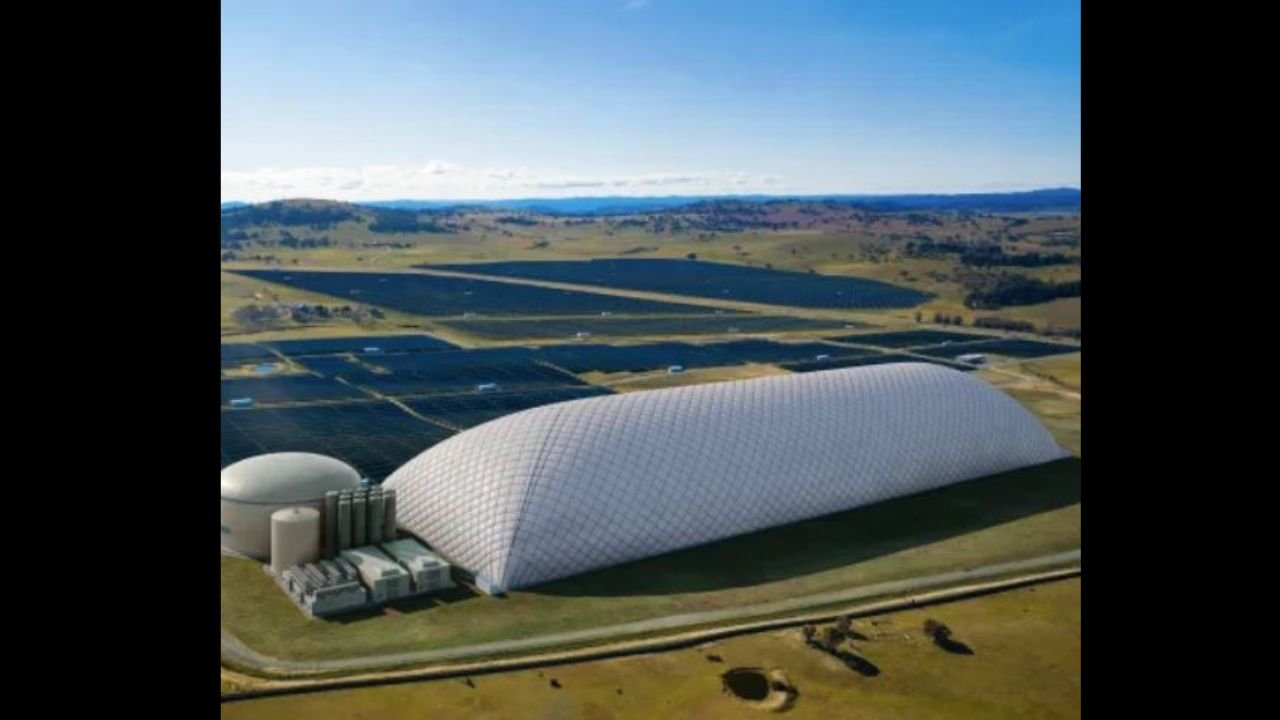
Ireland is preparing to host one of Europe’s most innovative energy storage projects, transforming a former peat-fired power station into a large-scale carbon dioxide battery facility. The project is the result of a commercial agreement between Google and Energy Dome, marking a significant step in the expansion of long-duration energy storage technologies.
The new installation will deliver 23 MW of power and provide 200 MWh of storage capacity, helping Ireland make better use of renewable electricity while reducing reliance on conventional battery materials. Scheduled to begin operations in 2028, the facility represents a new approach to storing clean energy without depending on lithium, cobalt or nickel.
From Power Plant to Energy Hub
The project is being developed on the site of a decommissioned peat-fired thermal power plant near the town of Rhode in County Offaly.
Instead of leaving the industrial site unused, developers are repurposing existing infrastructure to support Ireland’s growing renewable energy network. This strategy reduces the need for entirely new industrial developments while giving a second life to land previously dedicated to fossil fuel generation.
The location has already secured planning approval, land access and a long-term grid capacity agreement with EirGrid, Ireland’s national electricity transmission operator. Its position also makes it an important connection point for supplying electricity to the Greater Dublin region.
Why Energy Storage Matters
Renewable energy production does not always match electricity demand.
Wind farms often generate large amounts of electricity overnight or during periods of strong winds, while solar farms produce their highest output during daylight hours. However, homes and businesses may require more electricity at different times.
Without storage, excess renewable electricity can be wasted because the grid cannot always absorb every unit of energy generated.
Long-duration energy storage allows this surplus electricity to be saved and released later when demand increases or renewable generation declines.
How a CO₂ Battery Works
Unlike conventional batteries that rely on chemical reactions, Energy Dome’s technology uses a closed-loop thermodynamic process involving carbon dioxide.
During periods of excess renewable electricity, electrical energy powers compressors that convert carbon dioxide gas into a liquid under high pressure.
The compression process naturally produces heat, which is captured and stored in dedicated thermal storage systems instead of being released.
The liquid carbon dioxide is then safely stored inside specially designed steel tanks at ambient temperature until electricity is needed.
When demand rises, the stored heat converts the liquid carbon dioxide back into gas. As the gas expands, it drives a turbine connected to an electricity generator, returning clean power to the grid.
The carbon dioxide remains within the sealed system and is continuously reused.
A Lithium-Free Alternative
One of the project’s biggest advantages is its independence from traditional battery minerals.
Most large battery installations rely on lithium-ion technology, which requires materials such as lithium, cobalt and nickel. These minerals can face supply constraints, price volatility and environmental challenges linked to mining and processing.
The CO₂ battery avoids these issues by using widely available industrial materials, including steel, water and carbon dioxide.
Because the system does not depend on chemical battery cells, it also avoids many of the degradation issues associated with repeated charging and discharging.
Developers estimate the technology could operate for 30 to 40 years with minimal performance decline.
Supporting Ireland’s Wind Power
Ireland has become one of Europe’s leading producers of wind-generated electricity.
However, as an island nation with limited interconnection to neighbouring electricity markets, the country sometimes produces more wind energy than the grid can immediately use.
During these periods, renewable generation may need to be reduced, a process known as curtailment.
The new CO₂ battery offers a practical solution by storing surplus wind energy for up to 24 hours before returning it to the electricity network during periods of lower renewable output.
This helps improve overall grid efficiency while reducing energy waste.
Google’s Clean Energy Strategy
The Ireland project forms part of Google’s broader commitment to achieving around-the-clock carbon-free energy for its global operations.
Rather than purchasing renewable electricity alone, the company is increasingly investing in technologies that make renewable power more reliable and available throughout the day.
The partnership with Energy Dome represents Google’s first bilateral commercial deployment of carbon dioxide battery technology.
The agreement also supports future projects planned across Europe, North America and the Asia-Pacific region.
Earlier in 2026, Google announced support for a similar 19 MW / 200 MWh CO₂ battery project in Arizona, demonstrating growing confidence in the technology.
Future Expansion Plans
The Rhode site has been designed with future growth in mind.
Energy Dome intends to construct a second 200 MWh storage unit alongside the initial installation, creating an even larger regional energy storage hub.
Expanding storage capacity would allow the facility to absorb greater amounts of renewable electricity while strengthening grid stability during periods of fluctuating energy demand.
As renewable generation continues to increase across Ireland, additional long-duration storage projects may become increasingly important.
Benefits Beyond Ireland
Although the project is located in Ireland, its significance extends far beyond the country’s borders.
Many nations are searching for reliable methods of storing renewable electricity over extended periods without depending entirely on lithium-ion batteries.
If the CO₂ battery performs as expected, it could become an attractive option for countries seeking cost-effective, durable and environmentally responsible energy storage solutions.
Repurposing former fossil fuel facilities for clean energy infrastructure may also offer an efficient pathway for industrial transition in other regions.
The transformation of a former peat-fired power station into a carbon dioxide battery facility highlights how existing industrial sites can play a valuable role in the future of renewable energy. By combining innovative engineering with long-duration energy storage, the project aims to improve grid reliability while making better use of Ireland’s abundant wind resources.
With commercial operations expected to begin in 2028 and expansion already planned, the Rhode facility could become an important model for future clean energy developments worldwide. As electricity systems continue shifting toward renewable generation, technologies such as CO₂ batteries may become an increasingly important part of creating reliable, sustainable and resilient power networks.