
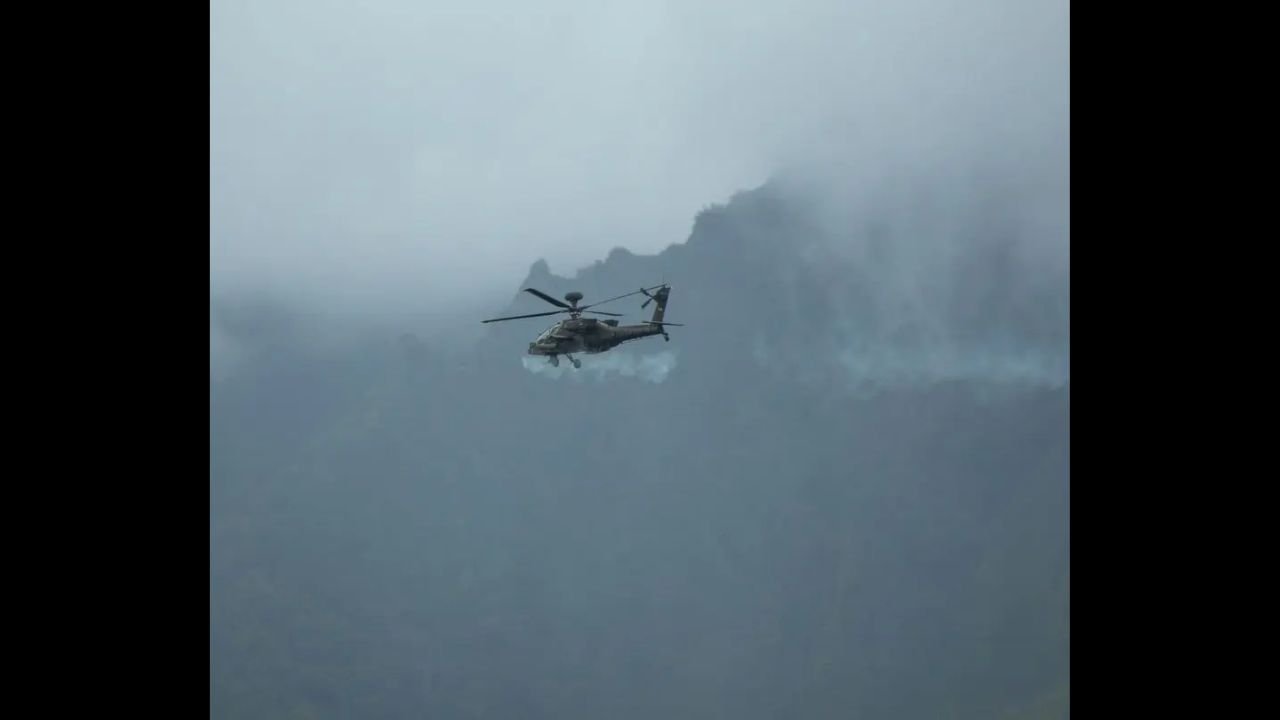
Two U.S. Army soldiers died after an AH-64 Apache helicopter crashed in Bell County, Texas, on Wednesday, August 12, 2026, during a military training flight. The aircraft went down in a field near Salado, north of Austin, and the impact triggered a large grass fire that added another emergency challenge for first responders.
The fatal crash involved a helicopter associated with Fort Hood and the Army’s 1st Cavalry Division. Officials have not yet released the names of the two soldiers, saying their identities would remain private until their families were notified.
The Crash
The helicopter went down at about 1:30 p.m. local time near FM 2843 in the Salado area. Emergency crews were dispatched after reports of the crash, and witnesses described heavy smoke rising from the field.
Both crew members aboard the Apache were killed. Bell County officials said the soldiers were pronounced dead following the crash, while their remains were transported to Carl R. Darnall Army Medical Center at Fort Hood.
The accident occurred roughly 50 miles north of Austin and close to the Fort Hood military installation, making the crash site an immediate focus for both local authorities and Army personnel.
Fire Erupts
The helicopter’s impact ignited vegetation around the crash location.
The resulting grass fire spread across the surrounding area and produced thick smoke, creating difficult conditions for emergency personnel. Several fire departments responded to contain the blaze.
Nearby residents were temporarily evacuated as firefighters worked to prevent the flames from threatening homes and other structures. Reports indicated that the fire eventually affected a significant area, although no homes were struck by the aircraft.
The crash also affected traffic. Authorities temporarily closed portions of FM 2843 because of the wreckage, smoke and firefighting activity.
Apache Crew
The AH-64 Apache is a two-person attack helicopter operated by the U.S. Army. Its crew consists of a pilot and a co-pilot/gunner seated in tandem.
The aircraft is designed primarily for armed reconnaissance and close air support and has been an important part of Army aviation for decades.
The Apache has been a familiar presence around Fort Hood, where Army aviation units conduct extensive training. The 1st Cavalry Division includes an Air Cavalry Brigade among its major formations.
The helicopter involved in Wednesday’s accident was confirmed as an Army AH-64 Apache based at Fort Hood.
Training Flight
Officials described the flight as part of routine military operations.
There was no immediate indication that the aircraft was involved in combat or an overseas mission. The crash instead occurred during peacetime military activity in Central Texas.
Army helicopter crews regularly conduct demanding training designed to maintain readiness. Such operations can involve low-level flying, maneuvering and coordination between aviation and ground units.
At this stage, however, officials have not identified what went wrong during the flight.
Cause Unknown
The cause of the crash remains under investigation.
Fort Hood’s criminal investigation division is leading the inquiry, while local agencies have assisted with securing the area and responding to the fire. Investigators will need to examine the wreckage, flight information, maintenance records and other evidence before determining what caused the helicopter to go down.
Authorities have not publicly attributed the accident to mechanical failure, pilot error, weather or any other specific factor.
That distinction is important because early information following a military aviation accident can change as investigators reconstruct the final moments of a flight.
Families Await Answers
The Army has withheld the names of the two soldiers pending notification of their next of kin.
For military families, such notifications are a formal and deeply significant part of the aftermath of a fatal accident. The Army generally waits until relatives have been informed before publicly identifying fallen service members.
Brig. Gen. Ethan Diven, acting commanding general, said the immediate focus was securing the crash site and supporting the affected families. His statement reflected the seriousness of the loss within the 1st Cavalry Division.
Texas Gov. Greg Abbott also expressed condolences following the deaths.
A Community Response
The crash brought together military personnel, sheriff’s deputies, firefighters and other emergency responders.
Local authorities quickly established control around the wreckage, while firefighters tackled the vegetation fire. The response was complicated by the rural setting and the need to preserve the crash site for investigators.
For residents near Salado, the incident also meant sudden road closures, smoke and evacuation orders.
Despite the disruption, authorities said the emergency response focused on protecting nearby residents while allowing investigators to begin their work.
Fort Hood Connection
Fort Hood, one of the largest U.S. Army installations, has a long association with Army aviation and the 1st Cavalry Division.
The division’s Air Cavalry Brigade operates alongside its armored and other combat formations, supporting training and readiness missions. The installation’s proximity to the crash site meant military officials could quickly join local responders.
The 1st Cavalry Division continues to conduct aviation and combat-readiness exercises as part of its broader training mission.
Investigation Continues
The Bell County Apache crash leaves two military families mourning while investigators work to establish exactly what happened.
For now, several critical questions remain unanswered: what caused the aircraft to lose control, whether any mechanical or operational problems were involved, and what occurred during the helicopter’s final moments.
Officials are expected to release additional information as the investigation progresses and as the families of the two soldiers are formally notified.