
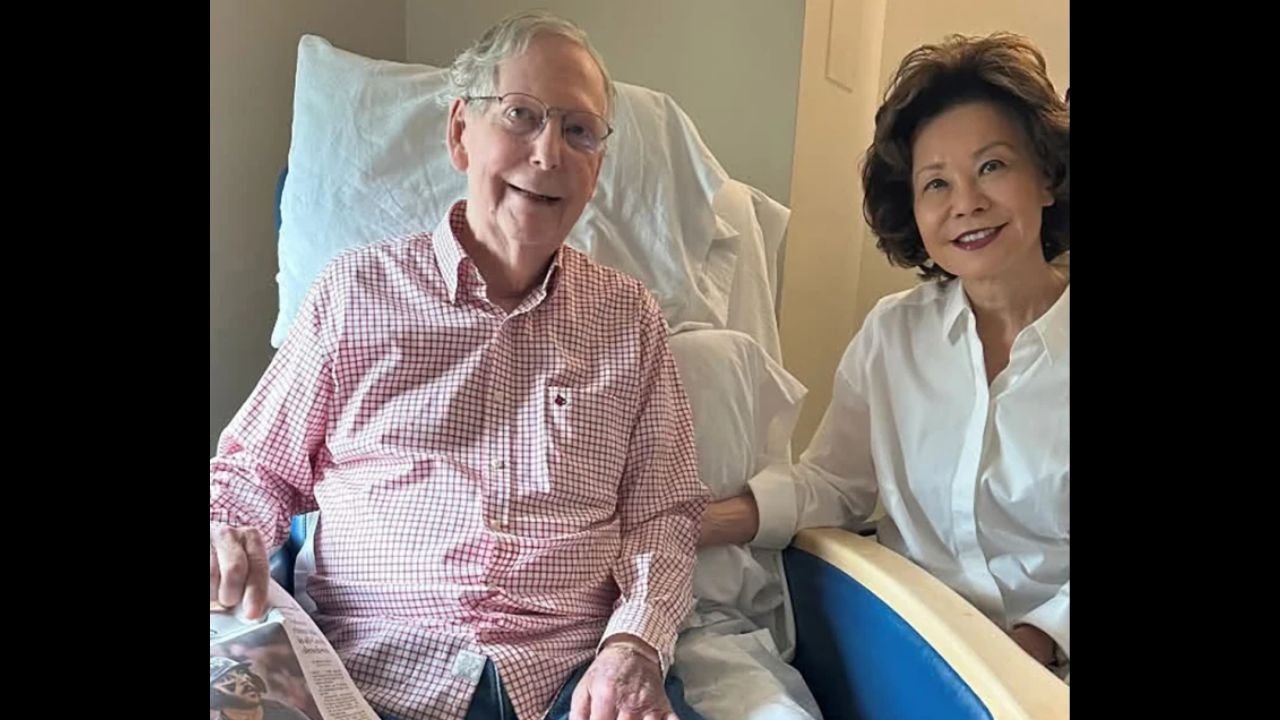
The release of a new photo of longtime Kentucky Senator Mitch McConnell has become one of the most discussed political stories in recent weeks. After nearly a month without any public appearance, the image immediately drew widespread attention across social media, television, and political circles. While the photograph was intended to reassure the public about the senator’s condition, it also fueled fresh debates about transparency, public trust, and the growing challenge of distinguishing authentic images from manipulated content in the AI era.
Here’s a closer look at the newly released Mitch McConnell photo, why it became controversial, and what has been confirmed so far.
Public Return
On July 12, 2026, Senator Mitch McConnell’s office released a photograph showing the 84-year-old Republican recovering in a hospital room.
In the image, McConnell is seated in a hospital bed beside his wife, former U.S. Labor and Transportation Secretary Elaine Chao. He is also holding the sports section of that day’s edition of The Washington Post, a detail widely viewed as an effort to establish when the photograph was taken.
The release marked McConnell’s first public appearance after weeks of silence following his hospitalization in mid-June.
Medical Update
Alongside the photograph, McConnell shared details about the health issues that kept him away from public view.
According to his statement, he experienced a fall at home on June 14 that caused him to briefly lose consciousness. During his recovery, he also developed a mild case of pneumonia that required medical treatment and additional observation.
His office indicated that his condition had improved and that he was continuing to recover under medical supervision.
The update answered many questions surrounding his absence while providing the first official explanation for his extended stay away from Capitol Hill.
Why It Drew Attention
Although the image was released to reassure the public, it quickly became one of the most debated political photographs of the year.
The senator had remained out of public view for nearly a month, allowing rumors and unverified claims about his health to spread rapidly across social media platforms.
Without regular updates from his office, online speculation intensified, with numerous users questioning his condition and whether he would return to work.
The hospital photograph was intended to address those concerns, but instead became the center of another wave of internet discussion.
Social Media Reaction
Within hours of its publication, thousands of users began analyzing every detail of the image.
Some questioned whether the photograph had been digitally altered, while others focused on the newspaper McConnell was holding, attempting to verify the publication date.
The debate reflected a broader trend in today’s digital landscape, where high-profile images often receive intense scrutiny before many people accept them as authentic.
Supporters viewed the photograph as sufficient evidence that the senator was recovering, while critics argued that additional public appearances or video statements would provide greater reassurance.
AI Rumors
Several online accounts claimed the image had been generated or manipulated using artificial intelligence.
These claims centered primarily on the appearance of the newspaper text, with some users arguing that blurred lettering resembled artifacts commonly associated with AI-generated images.
Others alleged the photograph had been recycled from an earlier hospitalization.
However, these claims quickly attracted attention from digital verification experts.
Expert Review
Independent digital forensic specialists and BBC Verify examined the original image after questions began circulating online.
Their review found no evidence that the photograph had been created or altered using artificial intelligence.
Experts explained that the newspaper text appeared unclear because of image compression and the lower-quality version shared online, not because of digital fabrication.
Metadata associated with the original file reportedly matched the timeline provided by McConnell’s office, supporting the conclusion that the photograph was genuine.
The findings helped reduce some of the misinformation circulating across social media, although debate continued among some online communities.
Fresh Debate
A second image released about a week later generated another round of discussion.
Some social media users noticed that McConnell appeared to be wearing the same shirt as in the earlier hospital photograph. This observation prompted additional speculation, with critics questioning whether both images had been taken on the same day.
No evidence has emerged proving the photographs were staged or misleading, and wearing the same clothing during a hospital stay is not unusual.
Nevertheless, the discussion illustrated how even small visual details can become major talking points in today’s fast-moving online environment.
Political Response
McConnell’s absence and the release of the photographs also prompted reactions from political leaders.
Some lawmakers called for greater transparency regarding the health of elected officials, particularly those serving in senior leadership positions.
Others argued that medical privacy should be respected while still providing enough information to reassure constituents.
Television commentators and late-night hosts also discussed the controversy, highlighting the public fascination surrounding the senator’s health and the internet’s rapid spread of speculation.
The episode reignited broader conversations about age, fitness for office, and communication during medical absences.
Looking Ahead
Despite weeks of recovery, McConnell has stated that he intends to complete his Senate term, which is scheduled to conclude in January 2027.
His office continues to provide periodic updates regarding his health, although no detailed timeline has been announced for a full return to public activities.
As discussions continue, the hospital photograph has become more than a simple medical update. It highlights the increasing difficulty public figures face in convincing audiences of authenticity in an era shaped by artificial intelligence, instant social media analysis, and widespread misinformation.