
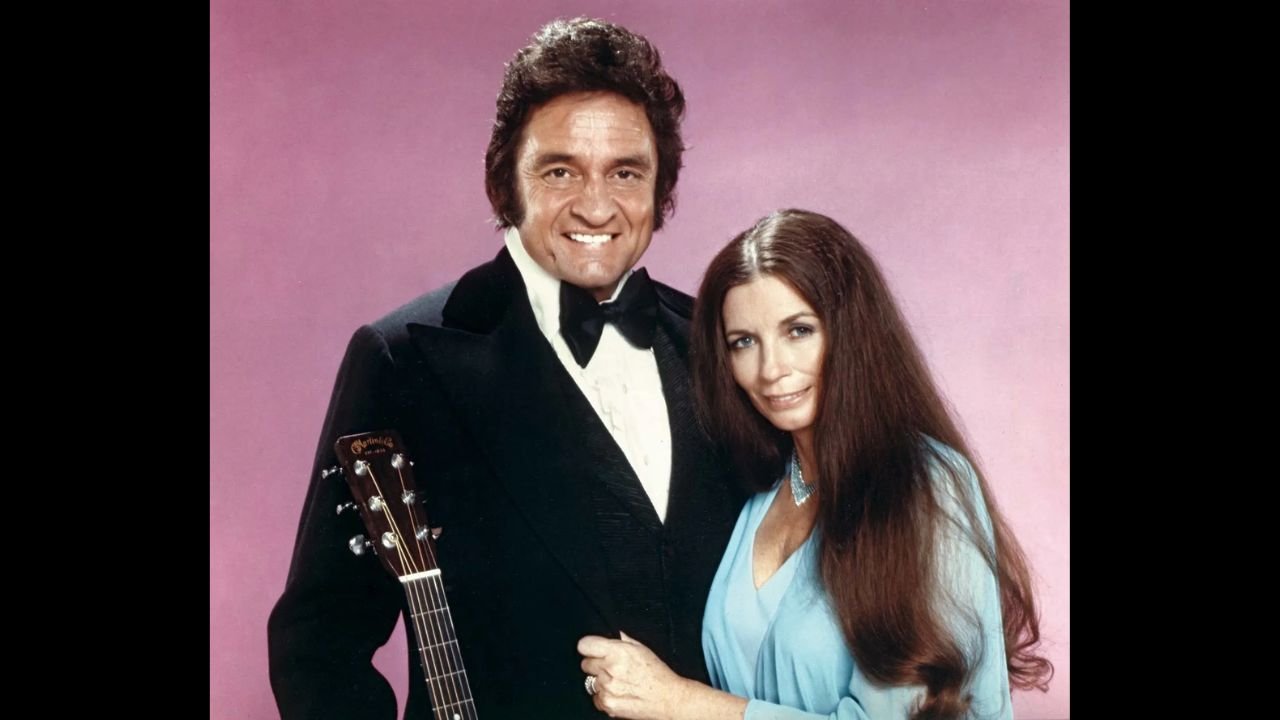
Johnny Cash remains one of the most recognizable figures in American music, decades after his death. His deep voice, spare guitar style and unmistakable stage presence helped him cross boundaries between country, rockabilly, folk, gospel and rock. More than a performer, Cash became a storyteller whose songs often focused on hardship, faith, regret, redemption and the lives of people living on society’s margins.
Born J.R. Cash on February 26, 1932, in Kingsland, Arkansas, he grew up in a working-class farming family before his family moved to Dyess, Arkansas. Those early experiences became an important part of the perspective he later brought to his music.
Early Rise
Cash’s professional breakthrough came after he traveled to Memphis and auditioned for Sam Phillips at Sun Records. The label became a launching pad for a remarkable group of young musicians, including Elvis Presley, Jerry Lee Lewis and Carl Perkins.
Cash developed a sound that was immediately different. His rhythmic guitar playing, unusually deep voice and straightforward songwriting gave his early recordings a distinctive character. Songs such as “I Walk the Line” helped establish him as a major country star while also attracting listeners beyond the genre.
His music was never confined neatly to one category. Cash could move from a hard-driving rockabilly number to a gospel performance or a quiet ballad without losing his identity.
The Man in Black
The nickname “The Man in Black” became inseparable from Cash’s public image. He frequently appeared onstage dressed almost entirely in black, creating a stark contrast with the brighter styles associated with many country performers.
The clothing was more than a fashion choice. Cash explained that black represented solidarity with people who were struggling, imprisoned, hungry or otherwise overlooked.
That sense of empathy became one of the defining characteristics of his career. He repeatedly used his platform to draw attention to prisoners, working people and communities that were rarely given a voice in mainstream entertainment.
Prison Shows
Cash’s relationship with incarcerated people became particularly visible through his legendary prison concerts.
His 1968 album At Folsom Prison captured the energy of his performance for inmates at California’s Folsom State Prison. The record became a major success and helped revive his career at a crucial moment.
A year later, At San Quentin documented another landmark prison performance. These recordings were important not simply because they were commercially successful, but because Cash treated the prisoners as an audience deserving respect rather than as outsiders.
His connection with prisons also influenced his songwriting, particularly songs that explored crime, punishment and consequences.
Career Highs
Cash produced an extraordinary catalogue throughout the 1960s and 1970s. “Folsom Prison Blues,” “Ring of Fire,” “A Boy Named Sue” and “I Walk the Line” became permanent parts of the American musical landscape.
His career also included collaborations with some of the biggest names in country music. The Highwaymen supergroup, formed with Willie Nelson, Waylon Jennings and Kris Kristofferson, became another major chapter in his story.
Cash’s achievements eventually earned him membership in several prestigious halls of fame, reflecting his influence across multiple musical traditions rather than within country music alone.
June Carter
One of the most important relationships in Cash’s life was with June Carter, a member of the celebrated Carter Family and an accomplished performer in her own right.
Their relationship developed while they worked together professionally. After years of friendship and romance, they married in 1968.
Carter became an important source of stability during Cash’s struggles with substance addiction and the pressures surrounding his career. The pair continued performing together for decades, creating a partnership that became part of country music history.
Their relationship later inspired the 2005 film Walk the Line, which introduced their story to another generation.
Personal Battles
Cash’s public success existed alongside serious personal difficulties. During parts of his life, he struggled with drug addiction and the consequences that came with it.
Rather than hiding those experiences completely, he often transformed them into music. His willingness to acknowledge mistakes, weakness and regret contributed to the emotional directness that made his work so powerful.
Faith was another constant theme. Gospel music remained important throughout his career, even during periods when his personal life appeared far removed from the religious ideals he expressed in his songs.
The Rubin Revival
Cash experienced an extraordinary late-career resurgence after beginning his collaboration with producer Rick Rubin in the 1990s.
The American Recordings project stripped away elaborate production and placed Cash’s voice and guitar at the center. The approach suited an artist whose greatest strength had always been his ability to make a song feel intimate and personal.
His later recordings introduced his music to listeners who had grown up with alternative rock and other modern genres.
“Hurt”
Perhaps the most striking example was Cash’s 2002 recording of Nine Inch Nails’ “Hurt.”
Cash transformed the song into something deeply personal. His aging voice and restrained performance gave the lyrics a different emotional weight, turning the recording into one of the defining moments of his final years.
The accompanying music video further reinforced the impression of an artist reflecting on mortality, memory and a life filled with both achievement and pain.
Final Years
June Carter Cash died on May 15, 2003. Her death profoundly affected Johnny Cash, who was already experiencing serious health problems.
Cash died on September 12, 2003, in Nashville, Tennessee, at 71. His death came only months after June’s passing.
Yet his influence did not end there. His recordings continue to reach new audiences, while his songs remain staples of country, rock and American roots music.
Johnny Cash’s importance lies not only in the number of records he sold or awards he received. His greatest achievement was creating a musical identity that could accommodate contradiction: toughness and vulnerability, rebellion and faith, fame and compassion.
He sang about prisoners without pretending to understand everything about their lives. He confronted addiction without presenting himself as flawless. He embraced spiritual themes while openly acknowledging his failures.
That honesty gave his music an unusual longevity.
More than two decades after his death, Johnny Cash remains the Man in Black—not simply because of what he wore, but because of the stories he chose to tell and the people he refused to leave out of the American songbook.