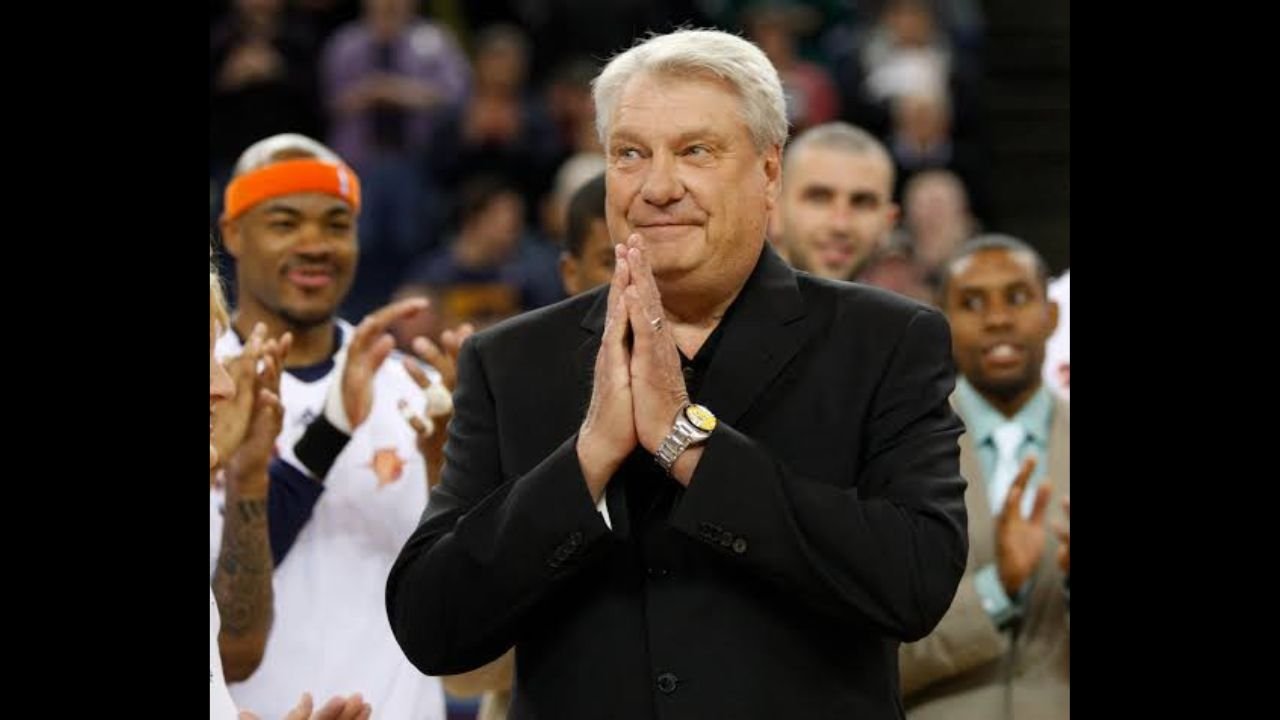
Don Nelson was one of the most unconventional figures in NBA history, a five-time champion as a player and a Hall of Fame coach whose ideas helped reshape the sport.
Nelson died at age 86 on August 9, 2026, his family announced. He passed away peacefully surrounded by relatives, according to the family statement. His death brought renewed attention not only to his remarkable basketball career but also to the Midwestern background and heritage that shaped him.
His Ethnicity
Nelson is generally described as white American, with family roots that have been reported as Danish.
He was born in Muskegon, Michigan, in 1940 and grew up in the Midwest. Accounts of his early life often emphasize his rural upbringing and the influence of farm life on his personality.
Claims about ancestry should be treated separately from modern racial categories. “White” describes a broad racial classification, while Danish refers to a specific European heritage. In Nelson’s case, the available biographical accounts connect his family background to Denmark while identifying him as an American of European descent.
Midwest Roots
Nelson’s upbringing was far removed from the polished world of professional basketball.
His early years were shaped by the Midwest, where he developed the toughness and independence that later became trademarks of his personality.
That background stayed with him even after he became an NBA star. Nelson was famously unconventional, comfortable challenging established ideas and rarely interested in behaving like a stereotypical sports executive.
His personality was part of what made him such a distinctive figure in basketball.
Five Rings
Before revolutionizing the NBA from the bench, Nelson established himself as a winner on the court.
He played 14 NBA seasons and became a key member of the Boston Celtics during their dominant championship years. Nelson won five NBA titles as a player, and Boston eventually retired his No. 19 jersey.
One of the signature moments of his playing career came during Game 7 of the 1969 NBA Finals against the Los Angeles Lakers.
Nelson hit a memorable high-arcing shot that helped Boston secure the championship. It became one of the enduring highlights of his Celtics career.
From Player to Coach
Nelson began his coaching career with the Milwaukee Bucks in the 1970s.
What followed was a 31-year coaching career involving the Bucks, Golden State Warriors, New York Knicks and Dallas Mavericks.
He accumulated 1,335 regular-season victories, a total that ranked second in NBA history by the time of his death, behind Gregg Popovich.
Nelson was also named NBA Coach of the Year three times, winning the award in 1983 and 1985 with Milwaukee and again in 1992 with Golden State.
Nellie Ball
Nelson’s biggest contribution to basketball may have been tactical rather than statistical.
His teams frequently ignored conventional positional roles. He experimented with smaller lineups, quicker offenses and players who could perform responsibilities traditionally assigned to someone else.
The approach became known as “Nellie Ball.”
Nelson was particularly influential in popularizing the point-forward concept, allowing larger players to initiate offense and create opportunities for teammates.
Many of the ideas he championed were considered unusual at the time but later became familiar features of modern NBA basketball. NBA historians and teams have repeatedly credited him with helping push the league toward faster, more flexible styles of play.
Global Vision
Nelson also had a reputation for seeing potential where others did not.
During his time with Dallas, he played a major role in the development of Dirk Nowitzki, the German forward who eventually became an NBA MVP and champion.
His coaching and basketball philosophy also helped Steve Nash flourish.
Nelson’s willingness to embrace international players and unconventional talent was part of a larger willingness to challenge the assumptions of traditional NBA basketball.
That vision became particularly important as the league became increasingly global.
Stephen Curry
Nelson’s influence eventually reached another generation through Stephen Curry.
Curry played his rookie NBA season under Nelson with Golden State. After Nelson’s death, Curry described his former coach as someone who challenged him immediately and gave him the opportunity to become the best player he could be.
Curry’s career would go on to transform the importance of three-point shooting.
While it would be too simplistic to credit Nelson alone for the modern three-point revolution, his willingness to embrace spacing, speed and long-range shooting made his basketball philosophy remarkably compatible with the game Curry later helped popularize.
We Believe
Nelson’s Golden State legacy includes one of the greatest playoff upsets in NBA history.
In 2007, the eighth-seeded Warriors eliminated the top-seeded Dallas Mavericks in the opening round.
Dallas had won 67 games during the regular season, while Golden State entered the playoffs as a significant underdog.
Nelson’s familiarity with the Mavericks added another layer to the series. The Warriors’ victory became known as the “We Believe” run and remains one of the defining moments in franchise history.
Beyond Basketball
Nelson’s personality was just as memorable away from the court.
After retiring from coaching, he spent much of his later life in Hawaii and became known for his relaxed lifestyle.
He also attracted attention for his response to the devastating 2023 Maui wildfires. Reports said Nelson made rental properties available to people who had lost their homes, giving displaced families a place to stay.
That chapter offered a different picture of the man fans knew as the colorful basketball innovator.
A Lasting Legacy
Nelson was inducted into the Naismith Memorial Basketball Hall of Fame in 2012. In 2025, he received the Chuck Daly Lifetime Achievement Award, another recognition of his extraordinary contribution to coaching.
His legacy cannot be reduced to his ethnicity or upbringing.
The Danish heritage associated with his family background was one part of his story, while his Midwestern upbringing, basketball instincts and willingness to experiment helped shape the personality that became known around the NBA as “Nellie.”
He finished his career with five championships as a player, 1,335 coaching victories and a collection of ideas that helped push professional basketball toward the faster, more positionless game seen today.
Don Nelson’s cultural roots may have begun in the American Midwest, but his basketball influence reached far beyond it. His ideas crossed borders, generations and traditional basketball boundaries, ensuring that his name will remain part of NBA history long after his passing.