
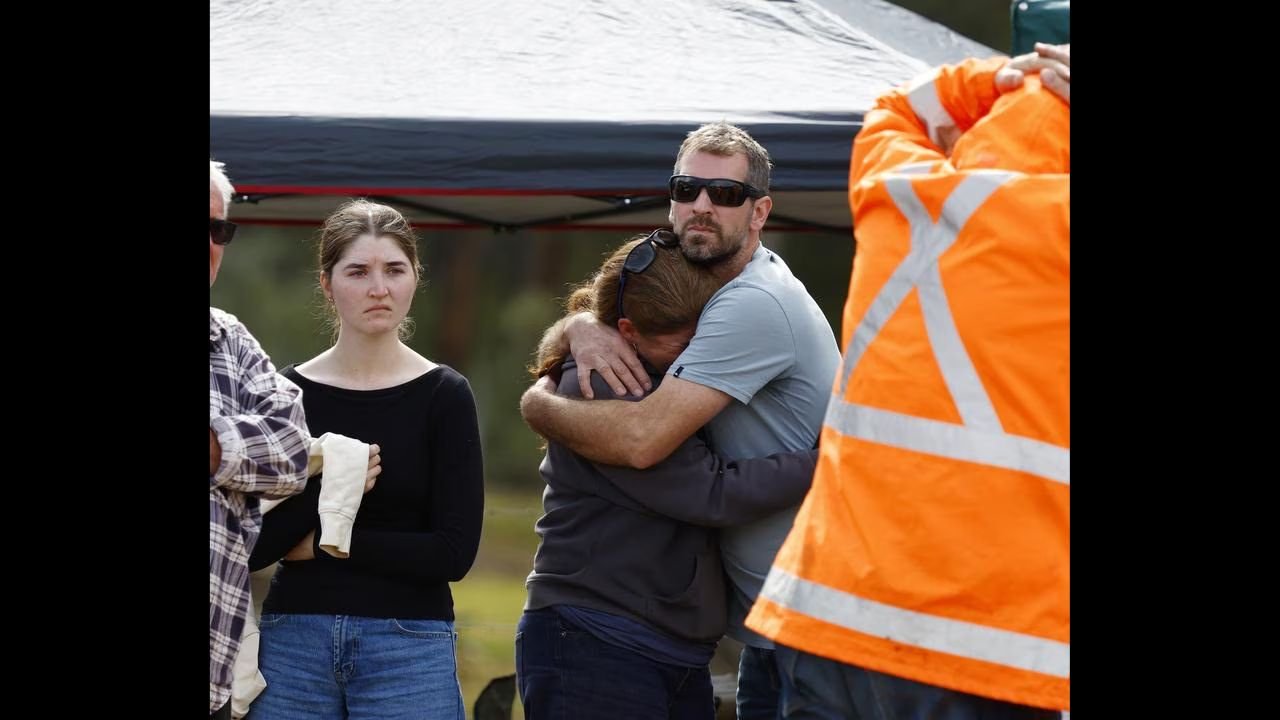
The search for 18-year-old Australian hiker Lily Hooper ended in tragedy after an extensive operation in New South Wales, leaving her parents, Jim Hooper and Kirrily Hooper, facing an unimaginable loss.
Lily was from Oakdale, New South Wales, and her disappearance prompted an eight-day search in the rugged Nattai National Park area. Her parents remained closely involved as emergency services, volunteers and other search personnel worked through difficult terrain to locate their daughter.
The circumstances surrounding the final hours of the search became even more painful after a serious communication error briefly gave the family hope that Lily had been found alive.
Who Are Her Parents?
Lily’s parents are Jim Hooper and Kirrily Hooper. The couple raised Lily in Oakdale, in the Macarthur region of New South Wales.
Unlike the public figures who frequently attract attention after a tragedy, Jim and Kirrily have largely remained private people. Much of what has become known about them has emerged because of their involvement in the search for their daughter.
Their presence throughout the operation reflected the desperation of a family waiting for news while search teams worked across a challenging national park landscape.
The Search
Lily’s disappearance triggered a major search operation involving police, emergency personnel and volunteers.
Nattai National Park is part of the Greater Blue Mountains region and contains extensive bushland and difficult terrain. Searching such an environment can be particularly demanding, with teams required to cover large areas while dealing with natural obstacles and limited visibility.
For eight days, the focus remained on finding Lily and bringing her home.
Her parents remained at the center of the heartbreaking wait, hoping that every update from investigators might provide a breakthrough.
A Shocking Mix-Up
The most distressing development came when search crews eventually located Lily.
Instead of immediately receiving confirmation of the tragedy, her parents were reportedly told that their daughter had been found alive.
The information was the result of a radio communication error at the search base. A message was incorrectly passed on to Jim and Kirrily, creating a moment of overwhelming relief after more than a week of uncertainty.
For Jim, the news initially appeared to mean that the nightmare was over.
Eight Minutes of Hope
The false information was corrected only minutes later.
Reports indicate that Jim briefly spoke to journalists while believing Lily had survived. Around eight to 10 minutes later, police personnel informed the family that the earlier message was wrong and that Lily had died.
The abrupt reversal turned what had seemed like a moment of extraordinary relief into another devastating blow.
For parents already enduring the anguish of an eight-day search, the mistake added another layer of trauma to an already unbearable situation.
Police Apology
The communication failure prompted an apology from New South Wales Police Commissioner Mal Lanyon.
Lanyon expressed regret to Lily’s parents over the error and the additional distress it caused them. The apology acknowledged that the family should never have been placed in a position where they were incorrectly led to believe their daughter was alive.
The incident also raised questions about how critical information is communicated during complex search operations, particularly when families are waiting nearby for updates.
Lily’s Final Search
The recovery of Lily brought the physical search to an end, but it did not end the questions surrounding what happened to the teenager.
As is standard in a death involving circumstances requiring investigation, authorities are expected to establish the circumstances surrounding her death. A coronial process can help determine the cause and manner of death and examine relevant evidence.
The focus for investigators is therefore separate from the communication failure that affected her parents. The two issues involve different questions: one concerns Lily’s death, while the other concerns how information about the discovery was conveyed to her family.
A Family Under Pressure
For Jim and Kirrily, the search was not simply another emergency operation. It was a deeply personal ordeal involving their daughter.
Parents of missing people often endure a particularly painful form of uncertainty because hope and fear exist simultaneously. Every passing hour can bring new possibilities, while the absence of answers becomes increasingly difficult to bear.
In Lily’s case, that emotional strain was intensified by the incorrect message that she had been found alive.
The brief moment of happiness followed by the confirmation of her death is likely to remain one of the most painful parts of the family’s experience.
Community Support
The search for Lily also drew attention from the wider community.
Large missing-person searches frequently depend on cooperation between professional emergency crews, volunteers and members of the public. In difficult bushland environments, local knowledge and extensive search networks can be crucial.
Following Lily’s death, attention shifted from the search effort toward mourning and remembering an 18-year-old whose disappearance had touched people well beyond her immediate family.
Remembering Lily
Although public information about Lily’s private life remains limited, the response to her disappearance showed how strongly her case affected the local community.
Her parents’ presence throughout the search became a central part of the story, particularly because of the extraordinary emotional circumstances surrounding the final discovery.
For Jim and Kirrily, however, Lily was not a missing-person case or a headline. She was their daughter.
The public focus will eventually move elsewhere, but for her family, the loss is permanent.
The circumstances of Lily’s death remain subject to the appropriate investigative and coronial processes. Those proceedings are important for establishing verified facts rather than relying on speculation.
The police communication error is also likely to remain under scrutiny because of its impact on Lily’s parents.
For Jim and Kirrily Hooper, the immediate priority is grieving their daughter after eight days of uncertainty, followed by the difficult process of coming to terms with a loss made even more painful by the brief and mistaken news that Lily had survived.
Their story is ultimately a reminder of the human cost behind a large-scale search operation—and of the profound impact that accurate communication can have when a family is waiting for news about someone they love.