
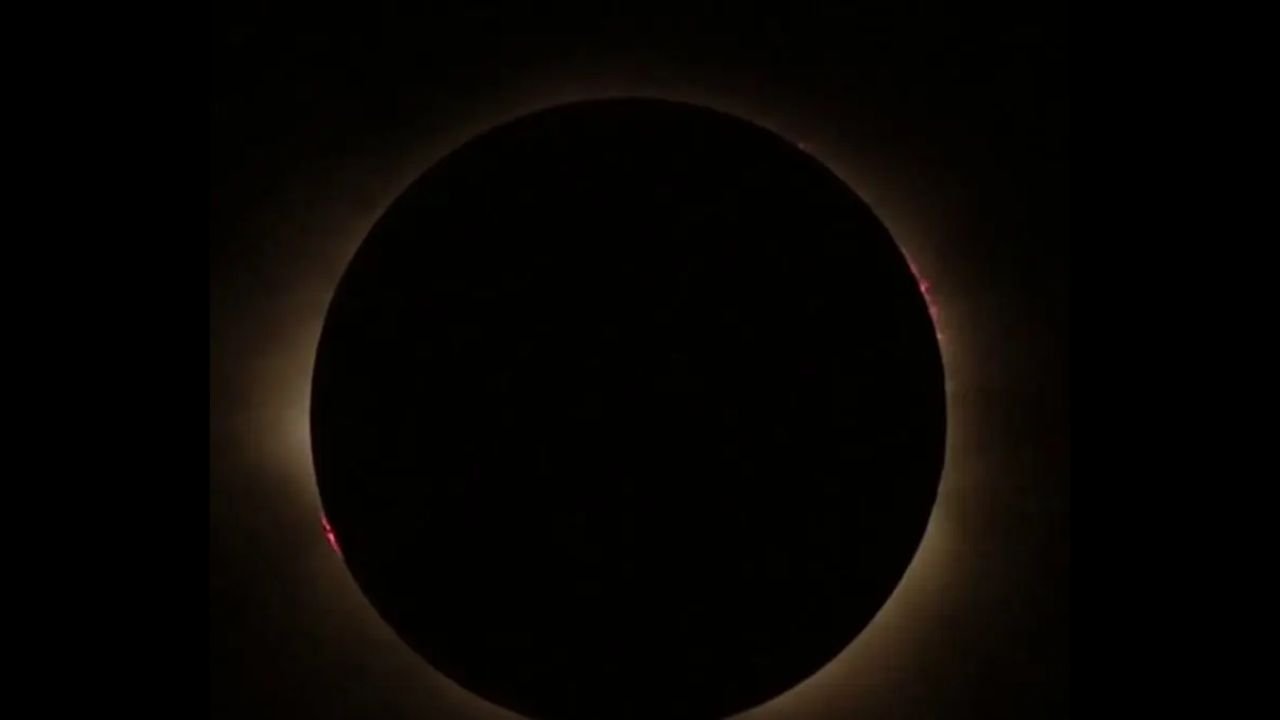
Spain witnessed a spectacular celestial event on Wednesday evening, August 12, 2026, when a total solar eclipse crossed parts of the country shortly before sunset.
The Moon moved directly between Earth and the Sun, briefly blocking the Sun for observers positioned along the narrow path of totality. Across northern and eastern Spain, people gathered at viewing locations to watch daylight fade as the eclipse approached the horizon.
The event reached its Spanish peak at roughly 8:30 p.m. local time, although the exact timing and duration differed from one location to another.
Shadow Arrives
The eclipse traveled across the Iberian Peninsula from west toward east, bringing totality to a selection of locations before the Moon’s shadow continued toward the Balearic Islands.
For observers inside the central path, the Moon completely covered the Sun for a short period. Areas outside that corridor did not experience full darkness but still saw a substantial portion of the Sun disappear.
Because the eclipse occurred so close to sunset, the low position of the Sun added another visual element to the spectacle.
Northern Spain
Several northern provincial capitals experienced totality during the final stages of the evening.
In Santander, totality began at approximately 8:26 p.m. and continued for around 1 minute and 2 seconds.
Oviedo experienced a longer period of complete coverage. Totality there occurred at about 8:27 p.m. and lasted close to 1 minute and 48 seconds.
La Coruña also entered the path of totality, with the complete phase lasting approximately 1 minute and 18 seconds.
The differences in duration were caused by each location’s position relative to the eclipse path.
Moving East
The Moon’s shadow continued across Spain as evening progressed.
In Zaragoza, totality arrived around 8:29 p.m. and continued for approximately 1 minute and 23 seconds.
Further east, Valencia experienced totality shortly after 8:30 p.m. The Balearic Islands also received the spectacle, with Palma de Mallorca reaching totality between approximately 8:31 and 8:33 p.m.
Palma recorded about 1 minute and 36 seconds of totality.
The sequence created a gradual eastward progression, with different communities experiencing the most dramatic phase within only a few minutes of one another.
Madrid Misses Totality
Spain’s capital was not located inside the narrow corridor where the Moon completely covered the Sun.
Madrid instead experienced a deep partial eclipse, reaching its maximum around 8:32 p.m.
The capital was close enough to the edge of the totality path to see a dramatic reduction in sunlight, but observers there did not experience the brief period of complete solar coverage seen farther north and east.
That distinction is important because even a deep partial eclipse does not produce the same conditions as totality.
Barcelona View
Barcelona also remained outside the main path of totality.
The city reached maximum eclipse at approximately 8:29 p.m., when a large portion of the Sun was obscured.
Although the Moon did not completely cover the solar disk, observers could still witness a striking change in the appearance of the Sun near the horizon.
The timing also meant that the eclipse unfolded against the backdrop of evening light, creating conditions different from a midday eclipse.
Sunset Effect
The timing of the event made Spain an especially interesting viewing location.
With the Sun already approaching the western horizon, the eclipse took place against a rapidly changing sky. As the Moon moved across the Sun, daylight weakened naturally toward sunset, while the eclipse further reduced the available sunlight.
For people watching from elevated locations or open horizons, the combination of sunset and totality offered an unusually dramatic setting.
The low solar altitude also meant that unobstructed views toward the horizon were especially valuable.
Weather Challenges
Not every observer along the broader eclipse route enjoyed clear skies.
Cloud cover affected views in parts of Iceland as the eclipse moved across Europe, illustrating how weather can determine whether an astronomical event is visible even when the timing and location are otherwise favorable.
In Spain, local weather conditions also remained an important factor for individual viewers. A perfectly positioned observer can still miss an eclipse if clouds block the Sun at the critical moment.
Eye Safety
Astronomers and safety experts repeatedly stressed the need for proper eye protection during the eclipse.
Looking directly at the Sun during the partial phases can cause serious and permanent retinal damage. Ordinary sunglasses are not sufficient protection.
Certified solar viewing glasses or appropriate solar filters are required when observing the partially eclipsed Sun.
During the brief period of totality, when the Moon completely covers the bright solar disk, observers within the path can view totality without solar glasses. However, protection must be put back on immediately before the Sun begins emerging again.
A Rare Event
Total solar eclipses occur when the apparent size of the Moon matches the Sun closely enough to cover the solar disk from Earth’s surface.
The path where totality is visible is relatively narrow compared with the much larger region that experiences a partial eclipse.
That makes each accessible total eclipse a major event for astronomy enthusiasts and casual observers alike.
For Spain, the August 12 spectacle offered millions of people the opportunity to witness one of nature’s most striking astronomical phenomena without traveling to another continent.
From Santander and Oviedo to Zaragoza, Valencia and Palma, the eclipse produced different moments of totality as the Moon’s shadow moved across the country.
Madrid and Barcelona, meanwhile, experienced deep partial phases rather than complete darkness.
The event’s combination of totality, sunset and a west-to-east progression made August 12, 2026, a memorable evening for skywatchers across Spain.
For those fortunate enough to stand beneath the path of totality, the few minutes surrounding sunset offered a rare reminder of the precise celestial movements that can transform an ordinary summer evening into an extraordinary astronomical spectacle.