
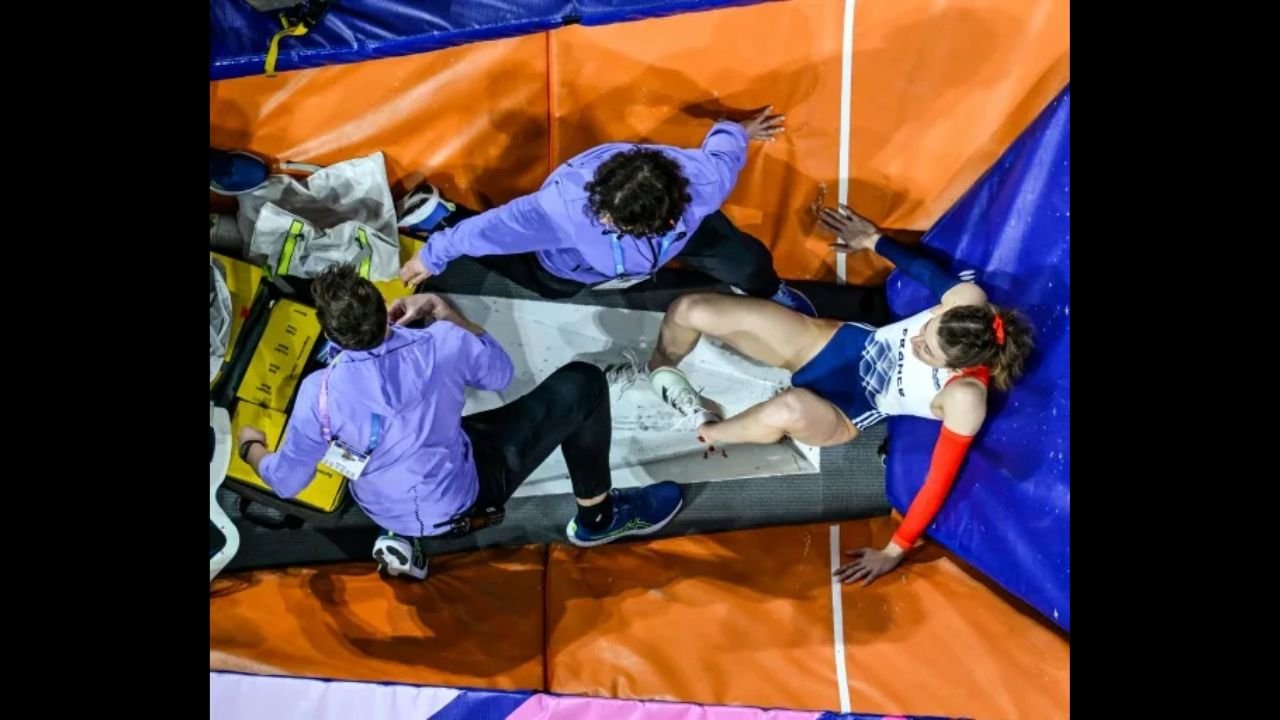
French pole vaulter Margot Chevrier suffered one of the most serious injuries of her career during the World Athletics Indoor Championships in Glasgow on March 2, 2024. What began as a routine attempt at 4.65 metres ended with a severe left-foot injury and an emergency medical response that brought the competition to a halt.
More than two years later, Chevrier’s story has moved beyond the accident itself. The French athlete has returned to competition, rebuilt her confidence and, during the 2026 season, has continued climbing back toward the level she showed before the injury.
The Fall
Chevrier was competing in the women’s pole vault final in Glasgow when she attempted 4.65 metres. After successfully clearing 4.55m on her third attempt earlier in the competition, she returned to the runway for another 4.65m attempt.
The jump went badly. Instead of completing the vault and landing safely on the mat, Chevrier fell back toward the take-off box. The resulting impact caused a severe open fracture involving the talus in her left foot.
The incident immediately stopped the competition as medical personnel attended to the injured athlete. She was eventually carried from the arena for hospital treatment.
A Serious Injury
The injury was far more than an ordinary ankle problem. Chevrier suffered an open fracture of the talus, an important bone involved in the ankle and foot.
Speaking days after the accident, she described the frightening reality of seeing her foot badly displaced. Her medical knowledge also gave her an unusually clear understanding of the seriousness of what had happened. Chevrier was studying medicine alongside her athletics career.
The immediate priority was not returning to competition. It was protecting the foot and beginning the process of reconstruction.
Two Operations
Chevrier underwent emergency surgery in Glasgow shortly after the accident. A second operation was planned in France as part of the longer reconstruction process.
The first procedure dealt with the immediate consequences of the open fracture, while subsequent treatment in France was necessary to continue repairing the damaged joint. Chevrier returned home to the Bordeaux area during the following week and began a lengthy rehabilitation program.
Her recovery quickly became a race against time because the Paris Olympics were only months away.
Olympic Dream
Initially, Chevrier refused to abandon the possibility of competing at Paris 2024. In the days immediately after surgery, she continued to express hope that she could somehow make the French Olympic team.
That ambition reflected her determination, but the medical reality proved difficult to overcome.
The French Athletics Federation ultimately did not validate her Olympic selection because she could not demonstrate the required level of competitiveness. In July 2024, the federation confirmed that she would not compete at the Paris Games.
For an athlete injured while preparing for a home Olympics, the disappointment was particularly painful.
The Long Recovery
Chevrier’s rehabilitation was measured in months rather than weeks. She had to rebuild strength and mobility while gradually becoming comfortable with the injured foot again.
Her return was not simply about physical healing. Pole vaulting requires an athlete to run at speed, plant a pole and generate enormous force through the take-off leg. After such a traumatic accident, trusting the body during that movement presented another challenge.
In 2026, Chevrier explained that adapting to her reconstructed foot had been a major part of her journey. Reports from the French athletics scene also highlighted that pain remained present, although she had become better at managing it.
Return To Competition
Chevrier eventually returned to competitive action in May 2025, approximately 14 months after the Glasgow accident.
Her first competition came at Salon-de-Provence. Competing with a shortened approach and a softer pole, she cleared 4.15 metres. The mark was well below her previous standards, but the result represented something much more important: she was competing again.
Her progression continued through 2025 and into 2026.
Stronger In 2026
The 2026 season has provided increasingly positive signs.
Chevrier cleared 4.40m at the Meeting de Montreuil in June and then won the Perche des Alpes competition in Grenoble on July 1 with 4.45m. She subsequently improved to 4.47m at Moulins and 4.50m at Talence, according to the French Athletics Federation’s results.
At the French Championships in Albi on July 25, she cleared 4.55m to finish second. That performance showed how far she had progressed from her tentative 4.15m comeback jump the previous year.
Beyond The Fear
Perhaps the most significant part of Chevrier’s comeback is not the height of the bar.
In June 2026, she spoke about overcoming the fear associated with the accident. Two years after the injury, she was still dealing with pain and limitations in movement, but the psychological barrier had become less dominant.
That distinction matters in pole vaulting. An athlete must commit fully to an explosive movement in which hesitation can affect both performance and safety. Regaining that trust after a catastrophic landing is a major achievement in itself.
A New Chapter
Margot Chevrier’s accident in Glasgow ended her hopes of competing at the Paris Olympics, but it did not end her pole-vaulting career.
Her journey from an open talus fracture in March 2024 to competitive heights above 4.50m in 2026 has been a gradual process of surgery, rehabilitation, patience and renewed confidence. Her 2026 performances demonstrate that she is once again a serious presence on the French pole-vaulting scene.
The Glasgow accident remains a defining moment in her career, but it is no longer the final chapter. Chevrier has returned to the runway, and her progress in 2026 suggests that the athlete who once dreamed of Paris is now building toward a different future on her own terms.